Image Compression Quality Settings Explained, With Real File Sizes
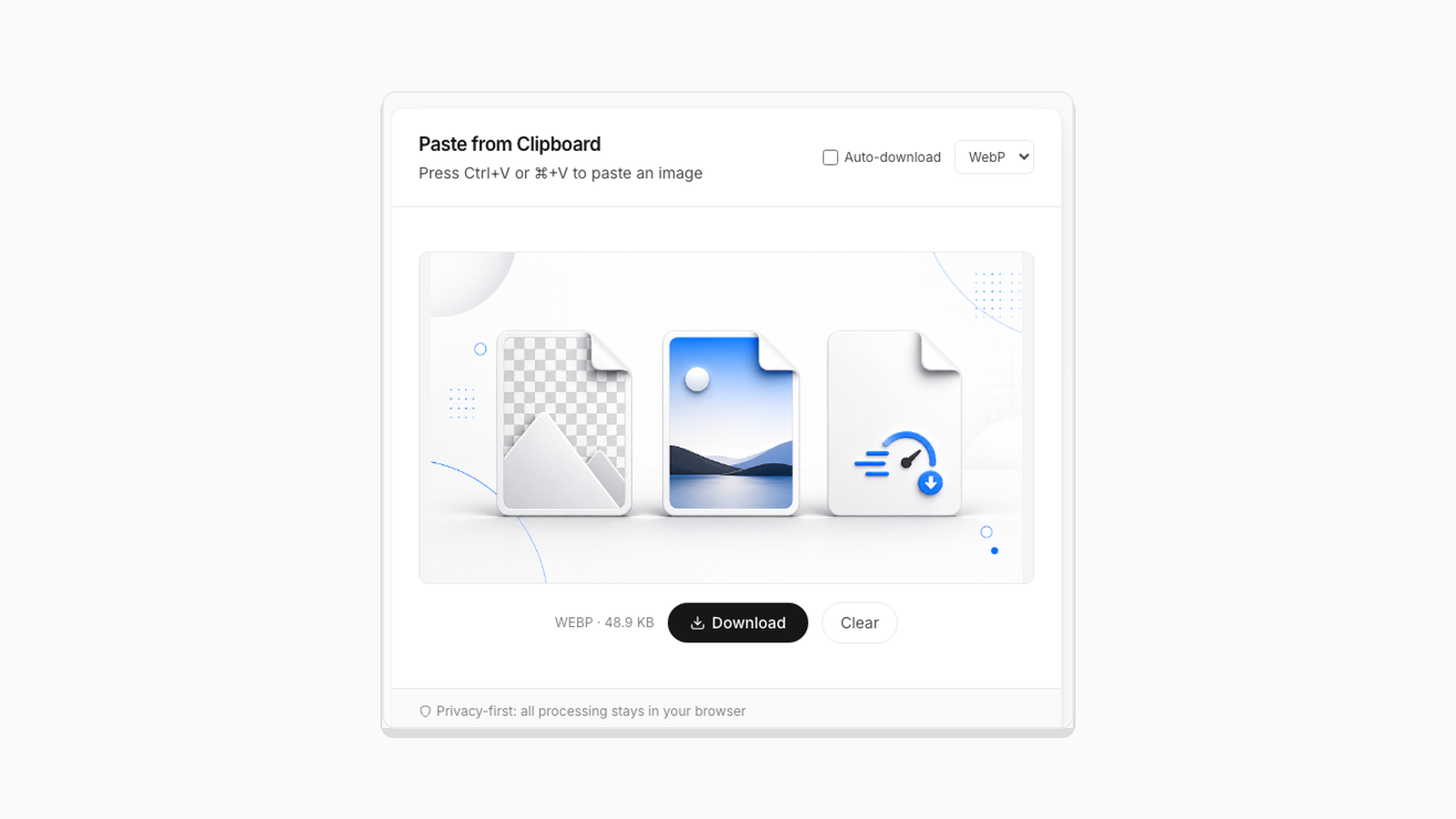
A "quality" slider in an image tool usually runs from 0 to 100 and gets treated like a magic dial: higher for better images, lower for smaller files. That is roughly right, but the number means something specific, and testing it on real files shows the tradeoff is not linear. Here is what quality actually controls, and what it did to two real files when I ran them through PasteDownloadApp's own conversion pipeline.
What the Quality Number Actually Does
For JPEG, the quality value controls how aggressively the encoder discards data during a step called chroma subsampling and DCT quantization, in plain terms, how much fine detail in color and texture gets rounded away to make the file smaller. At quality 100, very little is discarded and the file is close to lossless size. At quality 50, entire bands of visual detail get flattened, and you start seeing blocky artifacts around sharp edges. WebP's lossy mode uses a conceptually similar quality scale but a more efficient underlying codec, which is why it tends to produce smaller files than JPEG at a visually comparable quality level.
PasteDownloadApp does not expose an adjustable quality slider. It encodes JPEG and WebP output at a fixed 92%, chosen as a setting where compression artifacts are not visible on typical screenshots and photos, rather than exposing a dial most people would not know how to tune. Everything below is what that fixed 92% setting actually produces.
Real Result 1: A Photo-Style Illustration
Source file: a 1672×941 gradient illustration PNG, 1.15 MB on disk. Converting it through the tool at the default 92% quality:
- JPEG: 128.3 KB, a 89% reduction from the source PNG.
- WebP: 48.9 KB, a 96% reduction, and roughly 62% smaller than the JPEG at the same quality setting.
Real Result 2: A Screenshot With Text
Source file: a 624×575 UI screenshot with sharp text and flat colors, 140.2 KB on disk. Same 92% quality setting:
- JPEG: 37.6 KB, a 73% reduction, but with visible softening around the text edges under close inspection since JPEG's block-based compression struggles with high-contrast edges.
- WebP: 16.8 KB, a 88% reduction, and 55% smaller than the JPEG.
The pattern holds across both files: WebP consistently beat JPEG by roughly 55 to 60% at the same effective quality, and both formats compressed the photo-style illustration by a much larger percentage than the text-heavy screenshot, because JPEG and WebP's lossy modes are fundamentally built around smoothing photographic gradients, not preserving sharp text edges.
Why This Means PNG Is Still Right for Some Images
Neither JPEG nor WebP lossy mode can guarantee pixel-perfect text, because that is not what the compression is designed to preserve. If the image is going to be read closely, a screenshot of code, a diagram with small labels, a scanned document, PNG's lossless compression is worth the larger file size. If the image is a photo, a hero banner, or anything where a viewer will not compare it pixel by pixel against the original, WebP at high quality is very hard to distinguish from the source while being a fraction of the size. The full breakdown of when to use each format is in PNG vs JPG vs WebP.
Frequently Asked Questions
Can I set a custom quality percentage in PasteDownloadApp?
Not currently. The tool uses a fixed 92% quality for JPEG and WebP output, chosen to avoid visible artifacts without needing a setting most people would not know how to adjust.
Does a higher quality number always mean a bigger file?
Generally yes for the same image and format, but the relationship is not linear. Going from 92% to 100% typically adds far more file size than it improves visible quality, which is why most encoders default somewhere in the low-to-mid 90s rather than 100.
Why did WebP lossless produce a bigger file than WebP lossy in my testing elsewhere?
Lossless modes preserve every pixel exactly, the same tradeoff PNG makes, so they are usually larger than lossy output at a high quality setting. WebP's advantage over PNG shows up more in lossy mode than lossless mode for photographic content.
Related Guides
 PNG vs JPG vs WebP - Which Format Should You Save Your Image As? Learn the differences between PNG, JPG, and WebP, including quality, transparency, and file size.
 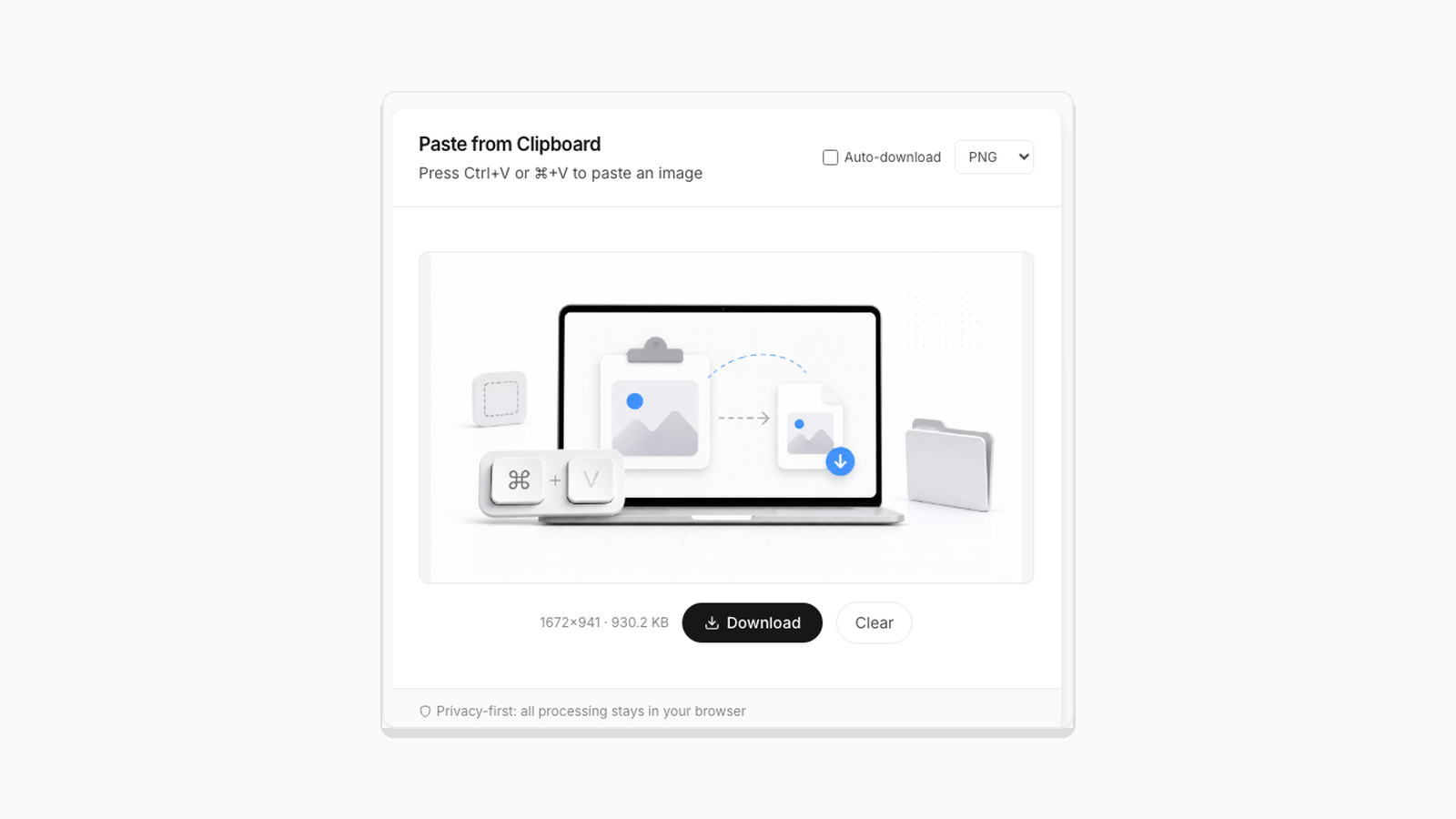 Why Re-Saving a PNG Can Make the File Bigger, Not Smaller A browser Canvas re-encode is not the same as a PNG optimizer. Here is the real size difference and why it happens.
  Preparing an Image for a Favicon, a Social Post, or a Resume Each use case has different size and format requirements. Here is what to pick and why, with real numbers.
 Test it on your own file at pastedownloadapp.com. Paste an image, switch between PNG, JPEG, and WebP, and compare the real size PasteDownloadApp reports for each.